
Most companies hand you a 30-day training manual after they leave. We do the training ourselves — on your property, on installation day, with your actual dog. After 25 years in Fairfield County and Westchester County, we believe that difference is everything.
When you call Freedom Fence to install an underground electric dog fence at your Connecticut or New York home, you are not getting a box of equipment and a PDF. You are getting a technician who will work hands-on with your dog before we leave your driveway — the same day the wire goes in the ground.
That is the single most important thing that separates a successful electric fence system from an expensive collar buried in a drawer. Training is not a follow-up step. At Freedom Fence, training is the installation.
The fence does not contain your dog. The training does. The fence is just the tool that makes the training work.
This article explains what our technicians actually do on your installation day — minute by minute — and what we ask you to reinforce in the two weeks that follow. If you want to understand what the system is and how it works before reading this, see our electric dog fence installation overview for CT & NY.
Why Same-Day Professional Training Works — and Why DIY Manuals Often Don’t
Every other electric fence company serving Connecticut and New York gives you training flags and a schedule. Follow this protocol for two weeks. Repeat sessions daily. Watch for these signs. Call us if something goes wrong.
That approach puts the entire weight of training on the homeowner — someone who has never trained a dog on a containment system before, working with a dog that does not yet understand what is being asked of it. The results are inconsistent. Dogs that miss sessions regress. Owners who read hesitation as fear increase anxiety. Correction levels get set wrong. Systems that would work perfectly end up earning a reputation for not working at all.
What makes same-day on-site training different is simple: an experienced technician reads your specific dog in real time. We have trained hundreds of dogs across Fairfield County, Westchester County, New Haven County, and Putnam County over 25 years. We know the difference between a dog who needs a lower correction level and a dog who is testing limits. We know how a Husky responds versus a Labrador. We know what good learning looks like and what fear looks like — and we adjust on the spot, not over a phone call three days later.
Properties in Fairfield County and Westchester County typically involve wooded boundaries, sloped lots, and active wildlife corridors — deer and coyote are common triggers for boundary testing. Our on-site technicians account for these specific environmental factors when adjusting your system’s correction level and training the initial boundary response.
This is not something a generic training schedule can factor in. It requires someone standing in your yard with your dog.
What Happens on Your Installation Day: A Full Walkthrough
Here is exactly what a Freedom Fence installation day looks like from arrival to departure. Every installation in CT and NY follows this sequence.
- Phase 1 — Arrival & Property Survey: We walk your property with you before any wire goes in the ground.We review your yard layout, identify any terrain challenges specific to Connecticut or New York properties (slopes, drainage areas, wooded edges), and confirm the boundary line that gives your dog maximum safe space while avoiding the correction zone near roads or property lines.
- Phase 2 — Installation: Wire installation, transmitter setup, and flag placement.We install the boundary wire and transmitter. We place white training flags along the entire perimeter — these are visual markers your dog will use to see the invisible boundary. We test the full system before any training begins.
- Phase 3 — Collar Fitting: We fit the receiver collar correctly on your dog — not you.Collar fit is the single most common point of failure in systems installed by other companies. Contact points must press against skin, not fur. We fit the collar, verify contact, and set the correct starting correction level for your dog’s size, coat, and temperament before any boundary training begins.
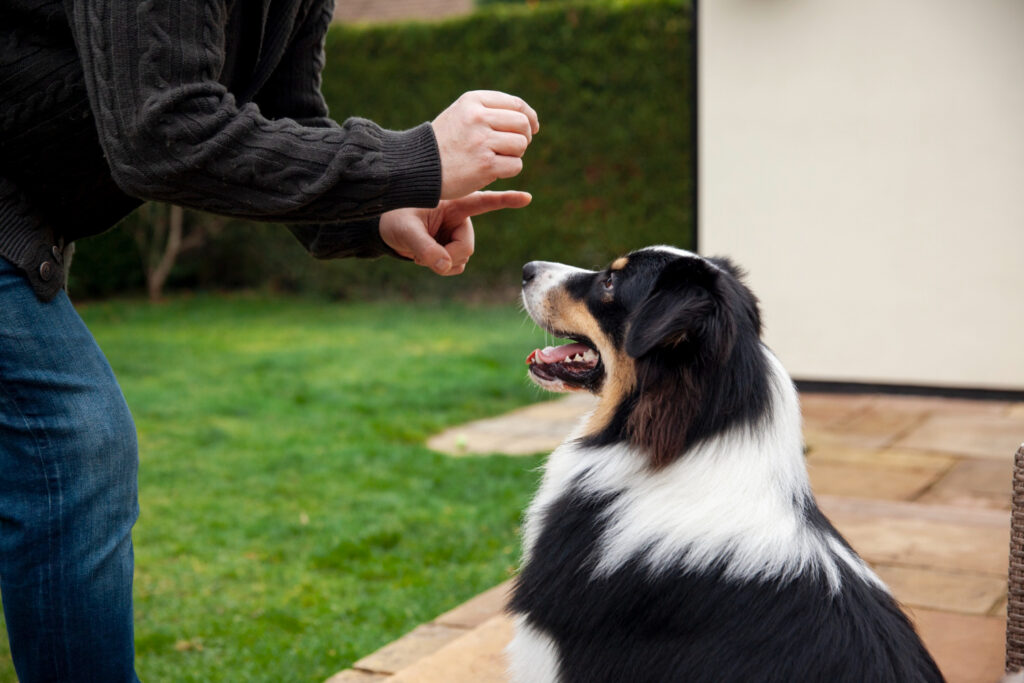
- Phase 4 — On-Site Training Session: We train your dog. On your property. That day.This is the core of the Freedom Fence difference. Our technician walks your dog on a long lead toward the flag line. When the collar issues its warning tone, we guide the dog back into the safe zone and reward immediately. We repeat this sequence — approaching the boundary, hearing the beep, turning back, receiving a reward — until the dog shows a clear, consistent response. For most dogs, this happens within a single session.
- Phase 5 — Owner Handoff : We show you exactly what to do — and what not to do — after we leave.Before we leave, we walk you through a brief, realistic reinforcement routine: short daily walks near the boundary for about two weeks, using the same reward structure. We answer every question you have. We leave you with a system that is already working — not a protocol to start from scratch.
What You Do After We Leave: Two Weeks of Simple Reinforcement
We want to be precise about this because other companies overstate the owner’s post-installation burden. Here is what is actually required after a Freedom Fence installation:
Two weeks of 10-minute daily reinforcement walks. That is it. You walk your dog near the flag line on a leash, the same way we showed you. When the collar beeps and your dog turns back, you reward with a high-value treat. When your dog ignores the boundary and engages with the yard interior, you reward. You are reinforcing a lesson that is already learned — not teaching it from scratch.
This is fundamentally different from the 30-day protocols that circulate online, which assume the dog has never seen the fence before and must be introduced, corrected, desensitized, and transitioned through multiple phases without professional guidance. Our dogs start the post-installation period already trained. The two weeks that follow are consolidation, not education.
Week 1: Daily 10-minute leash walks near the boundary. Reward turns away from the flag line. Build muscle memory for the warning tone response.
Week 2: Begin introducing minor distractions — family members at the perimeter, play near the boundary zone. Start removing every other flag. Supervised off-leash time in the yard interior.
By the end of Week 2, most dogs in CT and NY are reliably contained. Many are fully reliable within 10 days.
Does Same-Day Training Work for All Breeds? What We See Across CT and NY
In 25 years of installations across Connecticut and New York, we have trained every breed — from Chihuahuas to Great Danes, from Poodles to Siberian Huskies. Same-day professional training works for all of them. The variables that change are collar correction level, training pace, and owner reinforcement intensity — not the fundamental method.
| Breed / Type | Common in CT & NY | Training Note |
|---|---|---|
| Labrador Retriever | Very common — Fairfield & Westchester | High food motivation makes training fast. Watch for distraction chasing in Week 2. |
| Siberian Husky | Common — northern CT & Putnam County | Higher correction level typically required. Strong prey drive — distraction phase is critical. |
| German Shepherd | Common throughout CT & NY | High intelligence = fast learning. Can test boundaries analytically — consistency matters. |
| Beagle | Very common — suburban CT properties | Scent-driven. Wildlife corridors in CT are the primary challenge. Nose overrides correction when motivated. |
| Golden Retriever | Extremely common — Fairfield County | Typically responds quickly. Social curiosity near property lines — address during on-site session. |
| Mixed Breed / Rescue | Common — all service areas | Training pace varies. Our technicians assess temperament on-site and adjust accordingly. |
If your dog has a history of boundary breaking or has escaped from a previous electric fence system, tell us before installation day. We adjust our approach — typically starting at a higher correction level and extending the on-site training session — and we can schedule a follow-up visit if needed at no charge.
What Happens If Your Dog Tests the Boundary After We Leave
It happens. A squirrel moves fast enough, a neighbor dog appears at the right moment, and a dog who performed perfectly during our training session pushes through once. This does not mean the system failed. It means one of three things:
1. The collar contact needs to be rechecked. Dogs move. Collars shift. The most common cause of a post-installation breakthrough is a collar that has loosened and is no longer making proper skin contact. Check the fit first.
2. The correction level needs a slight upward adjustment — especially for high-drive breeds or dogs in CT and NY properties with significant wildlife pressure. We can walk you through this over the phone.
3. A reinforcement refresher is needed. Return to leash-guided walks near the boundary for two or three days. Dogs that pushed through once almost always re-establish respect for the boundary quickly with brief re-training.
If any of these situations arise, call us. Freedom Fence offers complimentary post-installation support for every system we install. Most questions are resolved in one phone call. If a site visit is needed, we come back. That is what 25 years of service in CT and NY looks like.
For systems that need a wire repair, collar replacement, or full diagnostic, see our electric fence repair service for CT & NY.
Frequently Asked Questions
Training is completed on installation day. Our technician works directly with your dog on-site during the visit. Owners reinforce the lesson with short daily walks over the following two weeks. Most dogs are fully reliable within 10–14 days of installation.
We recommend a minimum age of 6 months. Puppies younger than 6 months do not yet have the emotional maturity to process boundary training reliably, and starting too early can create lasting anxiety. We can advise on puppy-specific timing when you call for a property evaluation.
There are no statewide bans on underground electric dog fences in Connecticut or New York. However, some Homeowners Associations in Fairfield County and Westchester County have specific rules about containment systems. We recommend checking your local ordinances and HOA documents before installation. We can help you review these at no charge.
Yes. A prior escape history changes our approach, not our outcome. We typically start at a higher correction level, extend the on-site training session, and schedule a follow-up check within the first two weeks. In 25 years, we have not encountered a dog we could not contain.
Our technicians are trained to read fear versus hesitation versus boundary testing in real time. If a dog shows fear rather than learning, we reduce the correction level immediately and shift to positive-only reinforcement for the remainder of the session. No dog leaves installation day more anxious than they arrived.
Yes — always. Before we leave your property, we walk you through the exact reinforcement routine, show you how to check collar fit and contact points, explain what boundary testing looks like versus normal yard behavior, and make sure you know how to reach us if anything comes up. You leave installation day confident, not guessing.
More From Freedom Fence CT & NY
Ready for an Installation That Includes Same-Day Training?
Every Freedom Fence installation in Connecticut and New York includes professional on-site dog training — no extra charge, no separate appointment.
Book a Free Property Evaluation Call (203) 948-5367
Freedom Fence has specialized exclusively in underground electric dog fence installation and training in Connecticut and New York for over 25 years. Based in Brookfield, CT, our team has installed and trained on hundreds of properties across Fairfield County, New Haven County, Hartford County, Westchester County, and Putnam County. Every article on this blog reflects direct field experience — not theory.
17 Greenridge Dr, Brookfield, CT 06804 · (203) 948-5367 · freedomfencect-ny.com